What is the difference between andrographolide and Andrographis paniculata extract?

Andrographolide is a diterpenoid lactone-the active component found in Andrographis paniculata, a plant belonging to the Acanthaceae family. In procurement circles, it is often referred to as a "natural plant-based anti-inflammatory ingredient" or, colloquially, a "traditional Chinese medicine (TCM) antibiotic." Professionals involved in raw material sourcing, pharmaceutical formulation, or feed formulation typically focus on a few key aspects: purity specifications, testing methods, production processes, practical applications, quality differentiation, and supply chain stability. This article explores these topics from the perspective of raw material supply.
Andrographis paniculata is a classic medicinal herb from southern China, primarily cultivated in the Guangdong, Guangxi, Fujian, and Hainan regions. Industry insiders know that the concentration of andrographolide is significantly higher in the leaves than in the stems; therefore, reputable manufacturers prioritize using dried leaves as the raw material-a choice that largely determines the yield and purity of the final product. It is important to clarify a common point of confusion: "Andrographis extract" is not the same as high-purity andrographolide monomer. Extracts typically consist of a mixture of various lactones-such as dehydroandrographolide, neoandrographolide, and deoxyandrographolide-whereas the monomer is a single, isolated, and purified compound. Common commercial specifications include 98%, 90%, and 50% purity levels. The industry-standard method for analysis is High-Performance Liquid Chromatography (HPLC), which is the method recognized by pharmacopoeia standards and used in procurement contracts.
What are the pharmacological effects of andrographolide?
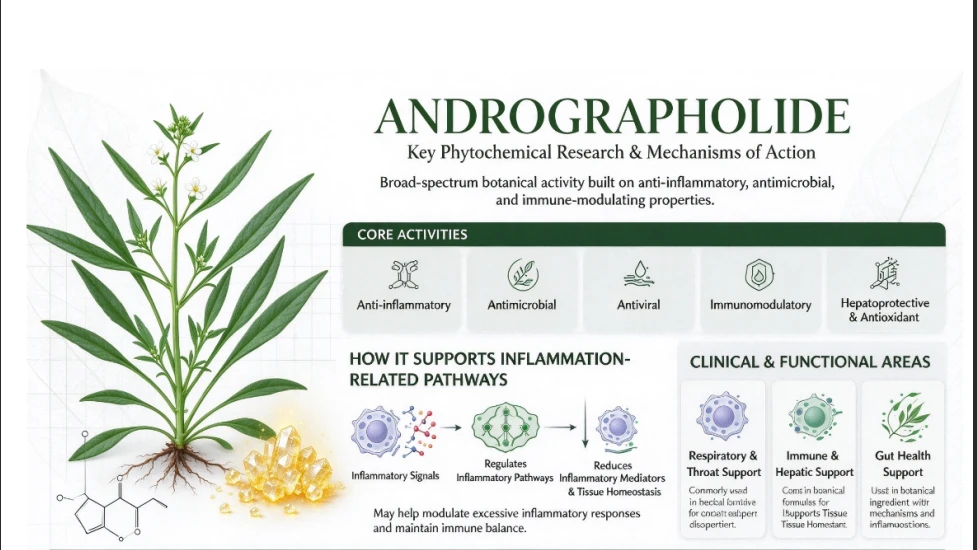
In terms of pharmacology, andrographolide is a relatively well-researched natural plant-derived compound. Its core value lies in its anti-inflammatory, antibacterial, antiviral, immunomodulatory, hepatoprotective, and antioxidant properties-which explains its broad range of downstream applications. In terms of anti-inflammatory properties, it regulates inflammatory pathways within the body and reduces the release of inflammatory mediators. It has long been used to address respiratory inflammation, sore throats, and intestinal inflammation. It serves as the core active ingredient in traditional Chinese medicine (TCM) preparations such as Andrographolide Dropping Pills and Andrographolide Tablets, which are frequently used for sore throats and upper respiratory tract infections caused by "wind-heat" (heat-type) colds.
Furthermore, it exhibits broad-spectrum antibacterial and antiviral effects. Unlike chemical antibiotics, it operates through a different mechanism, making the development of drug resistance less likely-a key reason why the veterinary medicine and feed additive sectors have shown significant interest in andrographolide in recent years. Existing literature also confirms its hepatoprotective (liver-protecting), choleretic (bile-promoting), antioxidant, and immunomodulatory properties. Ongoing research continues to uncover new potential applications, creating fresh opportunities within the "big health" ingredient sector.
Mainstream Extraction and Purification Processes for Andrographolide
Clients often ask: "How is this substance actually produced?" In the industry, processes are generally categorized into traditional methods and modern purification techniques. In the past, methods such as ethanol reflux extraction or cold maceration were common-soaking dried leaves in ethanol to extract the active compounds, followed by concentration and crystallization. While this approach requires lower capital investment in equipment, it has clear drawbacks: prolonged exposure to high temperatures can degrade the heat-sensitive andrographolide. Additionally, it results in a high level of impurities, placing a greater burden on downstream purification and increasing the risk of residual solvents. Consequently, high-standard, pharmaceutical-grade production rarely relies solely on reflux extraction today.
Leading extract manufacturers now typically employ a combined approach: ultrasonic or microwave-assisted extraction, followed by membrane separation for impurity removal, and finally, purification via recrystallization. Ultrasonic extraction enhances the dissolution efficiency of the lactones at relatively lower temperatures and shortens extraction time. Membrane separation effectively removes large-molecule impurities-such as polysaccharides, proteins, gums, and pigments-thereby easing the crystallization process and better preserving the compound's bioactivity. Through multiple rounds of recrystallization, a high-purity monomer powder is obtained. Higher purity correlates with a lighter color; a high-quality 98% grade product typically appears as a white or off-white crystalline powder. A key point to note here: Andrographolide is sensitive to high temperatures and will degrade if subjected to prolonged heating. Consequently, temperature control throughout the entire production process serves as a primary indicator for distinguishing between established, professional manufacturers and small-scale, informal workshops.
which are also the areas of greatest interest to procurement clients
In terms of pharmacology, andrographolide is a relatively well-researched natural plant-derived compound. Its core value lies in its anti-inflammatory, antibacterial, antiviral, immunomodulatory, hepatoprotective, and antioxidant properties-which explains its broad range of downstream applications. In terms of anti-inflammatory properties, it regulates inflammatory pathways within the body and reduces the release of inflammatory mediators. It has long been used to address respiratory inflammation, sore throats, and intestinal inflammation. It serves as the core active ingredient in traditional Chinese medicine (TCM) preparations such as Andrographolide Dropping Pills and Andrographolide Tablets, which are frequently used for sore throats and upper respiratory tract infections caused by "wind-heat" (heat-type) colds.
Furthermore, it exhibits broad-spectrum antibacterial and antiviral effects. Unlike chemical antibiotics, it operates through a different mechanism, making the development of drug resistance less likely-a key reason why the veterinary medicine and feed additive sectors have shown significant interest in andrographolide in recent years. Existing literature also confirms its hepatoprotective (liver-protecting), choleretic (bile-promoting), antioxidant, and immunomodulatory properties. Ongoing research continues to uncover new potential applications, creating fresh opportunities within the "big health" ingredient sector.
Mainstream Extraction and Purification Processes for Andrographolide
Clients often ask: "How is this substance actually produced?" In the industry, processes are generally categorized into traditional methods and modern purification techniques. In the past, methods such as ethanol reflux extraction or cold maceration were common-soaking dried leaves in ethanol to extract the active compounds, followed by concentration and crystallization. While this approach requires lower capital investment in equipment, it has clear drawbacks: prolonged exposure to high temperatures can degrade the heat-sensitive andrographolide. Additionally, it results in a high level of impurities, placing a greater burden on downstream purification and increasing the risk of residual solvents. Consequently, high-standard, pharmaceutical-grade production rarely relies solely on reflux extraction today.
Leading extract manufacturers now typically employ a combined approach: ultrasonic or microwave-assisted extraction, followed by membrane separation for impurity removal, and finally, purification via recrystallization. Ultrasonic extraction enhances the dissolution efficiency of the lactones at relatively lower temperatures and shortens extraction time. Membrane separation effectively removes large-molecule impurities-such as polysaccharides, proteins, gums, and pigments-thereby easing the crystallization process and better preserving the compound's bioactivity. Through multiple rounds of recrystallization, a high-purity monomer powder is obtained. Higher purity correlates with a lighter color; a high-quality 98% grade product typically appears as a white or off-white crystalline powder. A key point to note here: Andrographolide is sensitive to high temperatures and will degrade if subjected to prolonged heating. Consequently, temperature control throughout the entire production process serves as a primary indicator for distinguishing between established, professional manufacturers and small-scale, informal workshops.
Four Major Downstream Application Sectors for Andrographolide
Andrographolide is currently utilized across four primary downstream sectors-pharmaceutical active ingredients (APIs), veterinary drugs and feed additives, ingredients for health and wellness products, and cosmetic raw materials-which are also the areas of greatest interest to procurement clients.
Pharmaceutical preparations represent the largest application market. High-purity, monomeric andrographolide is used to produce oral "clearing heat and detoxifying" (anti-inflammatory/antiviral) formulations, such as drop pills, capsules, and tablets. It also serves as a starting material for derivatives; for instance, *yanhuning* (andrographolide sodium bisulfite) and *chuanhuning* (andrographolide potassium bisulfite) are products derived from structural modifications of andrographolide, accounting for a significant share of the pharmaceutical industrial chain. The threshold for pharmaceutical-grade raw materials is exceptionally high: purity levels, residual solvents, heavy metal content, microbial limits, and pesticide residues must strictly comply with pharmacopeia standards. Suppliers must maintain a comprehensive quality control system and provide an HPLC (High-Performance Liquid Chromatography) test report for every batch.
The veterinary drug and livestock/aquaculture feed additive sector has seen the most rapid growth in recent years. Following the implementation of domestic policies aimed at reducing or limiting the use of antibiotics, there has been a surge in demand for natural plant-based alternatives. When added to livestock and poultry feed in appropriate amounts, andrographolide can help alleviate respiratory and intestinal inflammation, boost immunity, and reduce the incidence of diarrhea and respiratory diseases. In aquaculture, its inclusion in feed for fish and shrimp helps combat *Streptococcus* infections, mitigate stress-related damage, and support the health of the hepatopancreas. Buyers in this sector often opt for medium-purity or standardized "total andrographolides." They tend to be more price-sensitive and place a strong emphasis on ensuring the product is free from prohibited additives, complies with the official catalog of permitted feed ingredients, and maintains batch-to-batch consistency.
The veterinary drug and livestock/aquaculture feed additive sector has seen the most rapid growth in recent years. Following the implementation of domestic policies aimed at reducing or limiting the use of antibiotics, there has been a surge in demand for natural plant-based alternatives. When added to livestock and poultry feed in appropriate amounts, andrographolide can help alleviate respiratory and intestinal inflammation, boost immunity, and reduce the incidence of diarrhea and respiratory diseases. In aquaculture, its inclusion in feed for fish and shrimp helps combat *Streptococcus* infections, mitigate stress-related damage, and support the health of the hepatopancreas. Buyers in this sector often opt for medium-purity or standardized "total andrographolides." They tend to be more price-sensitive and place a strong emphasis on ensuring the product is free from prohibited additives, complies with the official catalog of permitted feed ingredients, and maintains batch-to-batch consistency.
In the functional food and dietary supplement sector-leveraging research on its anti-inflammatory, liver-protective, and immunomodulatory properties-many companies combine andrographolide with other botanical ingredients to develop products aimed at soothing the throat or supporting liver health. However, it is crucial to remind industry peers that the use of this substance as an ingredient must strictly adhere to domestic regulations governing food ingredients. Furthermore, any claims regarding efficacy must remain within permitted legal boundaries; regulatory compliance is the fundamental prerequisite for the successful launch of any such product. In the skincare and cosmetics sector, andrographolide-valued for its antibacterial, anti-inflammatory, and soothing properties-is increasingly incorporated into anti-acne and soothing/repair formulations to address skin redness and acne-related inflammation. As a popular natural, functional ingredient, it is appearing with greater frequency in efficacy-driven skincare products.
For procurement professionals, the biggest challenges lie in verifying quality and avoiding substandard products. There is a wide price range in the market; low-cost offerings are often prone to issues such as adulteration, inflated specifications, excessive levels of dehydrated andrographolide derivatives, or non-compliance regarding pesticide residues and heavy metals. During the acceptance process, focus on several key areas: First, verify the test report to ensure it measures the andrographolide monomer specifically-do not mistake "total lactone content" for "monomer content." Second, examine the physical appearance; if a high-purity (98%) product appears yellow or brown, it is likely due to thermal degradation during production or an excess of impurities. Third, ensure strict control over four critical parameters: residual solvents, pesticide residues, heavy metals, and microbial content-standards that are mandatory for pharmaceutical-grade ingredients. Fourth, consider stability; andrographolide is sensitive to moisture and intense light. It must be stored in a sealed, light-protected, cool, and dry environment; improper storage can lead to a decline in active content over time.
There are also several considerations regarding its use. Andrographolide is characterized by a bitter, "cold" (cooling/damp-reducing) nature in traditional medicinal terms; when taken orally, it may cause gastrointestinal discomfort, nausea, or even diarrhea in some individuals-those with a "weak and cold" constitution (in TCM terms) should exercise caution. While severe allergic reactions are rare, a small number of individuals may be at risk; therefore, appropriate risk warnings should be provided during both product manufacturing and end-user application. Another formulation challenge is its poor water solubility. Developing products requires addressing both solubility and bioavailability; the industry is currently exploring technologies such as cyclodextrin inclusion complexes and nano-delivery systems to enhance absorption-a key area of ongoing R&D.
In summary: Andrographolide is a natural diterpenoid lactone monomer with a long history of use, extensive modern research, and a diverse range of downstream applications. When selecting this ingredient, procurement professionals, formulation engineers, and manufacturers should look beyond price; they must prioritize verifying purity specifications, testing methodologies, qualification documents, and batch-to-batch consistency. From an R&D perspective, there remains significant potential to explore structural modifications, novel formulation technologies, and entirely new application scenarios. As natural plant-based ingredients gain broader recognition, andrographolide will continue to deliver value across the pharmaceutical, livestock, and "big health" sectors, making it a specific product within the botanical extract industry that warrants long-term attention.
FAQ
Q1: Are andrographolide and "total andrographolides" the same thing?
A: No. Andrographolide is a single, specific monomer, whereas "total andrographolides" refers to the aggregate of various lactone components found in *Andrographis paniculata*.
Q2: Can andrographolide be added directly to animal feed?
A: It must be sourced as an ingredient that meets the specifications outlined in the official feed ingredient catalog and be incorporated in compliance with established formulation ratios.
Q3: How can the poor water solubility of 98% andrographolide be addressed?
A: In formulation, techniques such as cyclodextrin inclusion or micronization are commonly used to enhance its water solubility.
Contact us
Shaanxi Lv Ke Chun Yuan Biotechnology Co., Ltd.
Our address
Huaxia Yue World, Weibin District, Baoji City, Shaanxi Province,china
86-139927607929(Grace liu sales manager )