Key Emerging Trends in the Plant Extract Industry
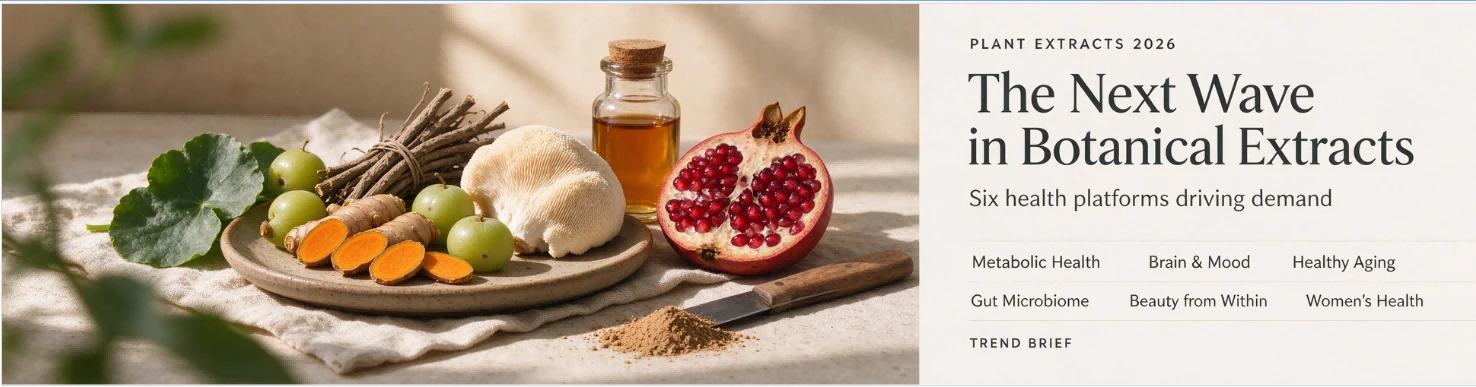
1. Evidence-Driven Approach: Moving Beyond HPLC-Assay Values. Major international clients-including dietary supplement and cosmetic brands-now demand comprehensive data packages rather than simple certificates of analysis. These requirements include in vitro /cellular studies, human clinical trial literature, marker profiling, formulation compatibility, stability data, risk assessments, and regulatory compliance documentation. The focus has shifted toward the synergistic effects of active component groups, rather than relying on a single, highly purified compound. Key areas of interest include: metabolic health (GLP-1 support, blood sugar control, and weight management-often utilizing berberine, amla, or turmeric blends); brain health and mood (ashwagandha, Bacopa monnieri, and lion's mane mushroom); healthy aging (joint, muscle, cognitive, and skin health); gut microbiome; beauty-from-within" (antioxidant, anti-glycation, and photoprotection); and women's cycle-related health.
2. Advancements in Blended Ingredients, Pre-formulations, and Delivery Systems. Technologies such as microencapsulation, cyclodextrin inclusion, liposomes, and nano-dispersions are being used to address common challenges-such as poor water solubility, low bioavailability, and susceptibility to oxidation-found in polyphenols, curcumin, and anthocyanins. Many clients now opt for "ready-to-use" blended ingredients to reduce the costs associated with formulation R&D.
3. Customization for Niche Applications. There is growing demand for specialized solutions, including heat-stable, acid/alkali-resistant, and taste-masked ingredients for food and beverages; gentle, skin-barrier-repairing, microbiome-balancing, and non-irritating ingredients for skincare; as well as targeted solutions for the pet nutrition and sports nutrition sectors.
Labeling and Compliance: "Clean Label" and End-to-End Traceability
1. High-end brands-both in Western markets and domestically-prioritize products that are free from synthetic solvents, artificial excipients, allergens, and irradiation, while favoring those with organic or wild-harvested certifications. Natural colorants and natural preservatives (such as rosemary extract and tea polyphenols) are increasingly replacing synthetic additives.
2. Rigorous Traceability Requirements: Essential data points include origin, cultivation batch, pesticide residue/heavy metal levels, processing records, and adulteration screening (via DNA analysis or fingerprint profiling). As regulatory thresholds-such as those set by GB/T, EFSA, FDA GRAS, and the EU's CosIng database-continue to rise, raw materials prone to adulteration or significant batch-to-batch variability are being phased out.
3. Upgraded Sustainable Sourcing: This encompasses organic cultivation, fair trade practices, and commitments to biodiversity. Furthermore, the "upcycling" of by-products-extracting active ingredients from peels, pomace, seeds, stems, or leaves (e.g., grape pomace, olive pomace, citrus peels)-has become a highly attractive selling point for beauty brands, aligning with circular economy principles.
Technological Evolution: A Dual-Track Approach-Green Extraction and Biomanufacturing (Cell Factories & Synthetic Biology)
1. Widespread Adoption of Green Extraction: Techniques such as supercritical CO₂ extraction, subcritical water extraction, enzyme-assisted extraction, ultrasound/microwave-assisted extraction, membrane separation, and continuous countercurrent extraction are gaining traction. These methods-which utilize minimal or no solvents (such as ethanol), consume less energy, and allow for solvent recovery-not only serve as eco-friendly marketing claims but also reduce the risk of solvent residues, facilitating "clean label" certification.
2. Plant Cell/Hairy Root Culture and Synthetic Biology: These represent long-term growth drivers. They are independent of geographical origin, seasonal fluctuations, pesticide use, or the limitations of continuous cropping. These methods offer high batch-to-batch consistency and the enrichment of targeted active ingredients. Ingredients derived from cell cultures-such as those from snow lotus, ginseng, *Arabis* (rock cress), or basil hairy roots-are already being utilized in high-end cosmetic product lines. Meanwhile, synthetic biology is being used to produce compounds like steviol glycosides and specific flavonoids; this complements traditional extraction methods and helps lower the costs of otherwise scarce raw materials.
3. AI and Digital Empowerment: AI is being leveraged to screen for bioactive plants, predict optimal extraction parameters, rapidly identify adulteration through fingerprint profiling, and forecast formulation stability. These applications shorten the development cycle for new products and enhance the efficiency of quality control.
Shifts in Market Structure: Dual Circulation (Domestic & International) and Distinct Customer Segmentation
1. Exports: Dietary supplements and dermocosmetics for Western markets (Europe and the U.S.) remain the primary drivers. Demand is surging in emerging markets across Southeast Asia and Latin America, though regulatory landscapes vary significantly. Price wars in commoditized raw ingredients continue to compress profit margins, whereas high-value-added standardized ingredients and customized solutions command a premium.
2. Domestic Demand: The domestic market for functional foods, freshly prepared tea drinks, ingestible beauty products, and efficacy-driven cosmetics is accelerating. Domestic brands are increasingly aligning their requirements for the scientific validity and regulatory compliance of botanical extracts with international standards, moving beyond a sole focus on low pricing.
3. Channel Evolution: Brands increasingly favor co-development and collaborative innovation directly with primary manufacturers, rather than relying on simple reselling by traders. Vertical integration-encompassing proprietary cultivation bases, extraction facilities, and efficacy-testing laboratories-has become the industry standard for leading suppliers.
Key Ingredient Trends (Food & Cosmetics)
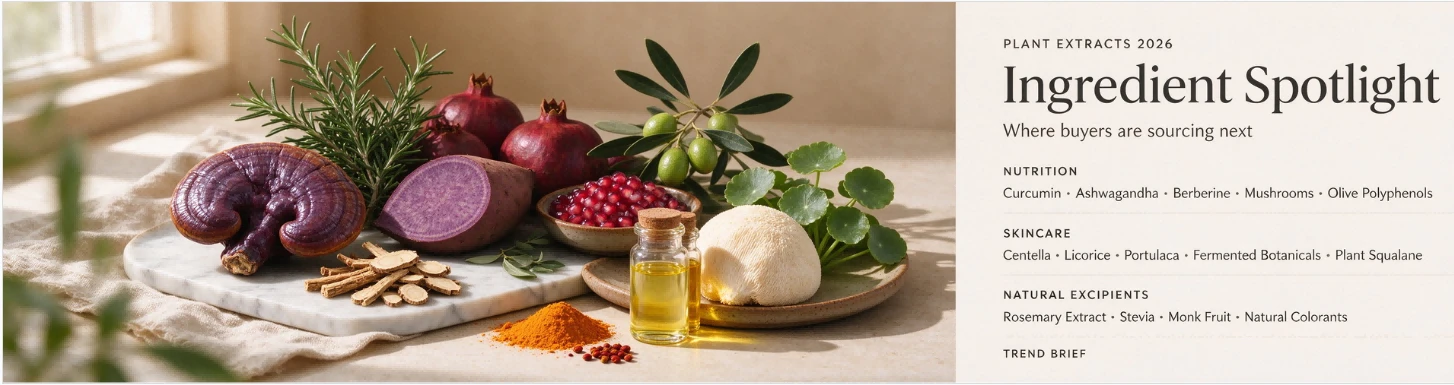
Nutrition & Health: Curcumin (high-absorption forms), Ashwagandha, Berberine, Amla (Indian gooseberry), Pomegranate polyphenols, Anthocyanins, Mushroom extracts (Reishi/Lion's Mane), Rosa roxburghii (prickly pear), and Olive polyphenols.
·Cosmetics: Licochalcone, Centella asiatica (Gotu kola), Portulaca oleracea (purslane), Fucoidan, Ergothioneine (plant-derived), Plant-based squalene, Anti-inflammatory polyphenols of botanical origin, and Fermented botanical extracts (fermentation enhances bioactivity and reduces irritation).
Contact us
 Shaanxi Lv Ke Chun Yuan Biotechnology Co