Structural differences: The presence or absence of sugar groups is the key
The fundamental difference between the two lies in their molecular structure:

Baicalin: It is formed by the combination of baicalein with a glucuronic acid molecule. It can be regarded as baicalein with a "sugar tail" attached to it.
Baicalein: This is the "bare" molecule without the "sugar tail".
This "sugar group" not only makes their chemical properties (such as solubility) different, but also directly determines their different "fates" after entering the human body.
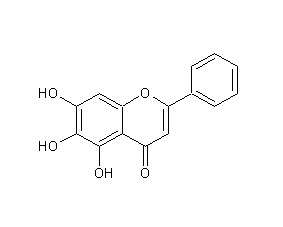
Core differences: Absorption, Transformation and Activity
The most core difference between the two lies in the absorption and transformation processes, which can be summarized in the following table:
It can be seen that kaempferol is usually regarded as the key substance that plays a major role because of its fast absorption and high bioavailability. After oral administration of kaempferol glucoside, it needs to "de-sugar" and transform into kaempferol before being utilized by the body. Therefore, kaempferol can be regarded as the "active form" of kaempferol glucoside.
Activity differences: The influence of lipophilicity
Due to the different structures, the lipophilicity of the two is also different. The lipophilicity of kaempferol (the aglycone) is stronger, which may give it an advantage in penetrating the cell membrane and showing stronger biological activity in some in vitro experiments. However, this does not mean that kaempferol glucoside is useless. It can act as a stable "storage form" or "transport form" of kaempferol in the body and may also play a unique role in the local intestinal area.
Core Activity Differences: Direct Action vs. Sustained Release Regulation
According to current research, their efficacy mainly manifests in the following aspects:
The speed and manner of anti-inflammatory activity are different: In cell experiments, baicalein often shows stronger and more rapid anti-inflammatory activity because it can directly enter the cell nucleus and quickly inhibit pro-inflammatory signals (such as the NF-κB pathway). While the anti-inflammatory effect of baicalin is often more "indirect", it enters the bloodstream and maintains a certain concentration, equivalent to a relatively stable "reservoir", and needs to be converted into baicalein in the body before it can exert its effect. However, this process also gives it a more persistent characteristic.
The antioxidant mechanisms have different focuses: Both can activate the cell's own antioxidant system (the Nrf2 pathway), but baicalein, due to its lipophilicity, can more easily enter the mitochondria (the cell's energy factory) and directly eliminate the free radicals there, protecting the energy supply. Baicalin, on the other hand, tends to function in the cytoplasm and extracellular fluid, like "outer defense fortifications".
Regulation of the intestinal flora: This is a crucial distinction that is often overlooked. A large portion of baicalin reaches the large intestine intact and becomes "food" for the intestinal flora, indirectly influencing the overall metabolism and immunity by regulating the composition of intestinal microorganisms. While baicalein is mostly absorbed before reaching the large intestine, its direct impact on the intestinal flora is relatively smaller.
Potential tendencies in application scenarios
Based on the aforementioned differences, they also exhibit different potential tendencies in research applications:
For rapid stress response: In models where rapid responses to acute oxidative damage or inflammatory stimuli are required, the research attention on baicalein is higher.
For intestinal health and systemic regulation: In scenarios involving intestinal barrier repair, microbiota regulation, or the need for slow drug release, baicalein, due to its "prodrug" characteristics and intestinal targeting, may have an advantage.
For specific neuroprotection: In the field of neuroprotection, baicalein has more extensive research due to its ability to more effectively penetrate the blood-brain barrier and act rapidly on nerve cells; while baicalein may indirectly provide support by improving cerebral blood circulation or regulating peripheral immunity.
Baicalein 98%

Baicalin 98% is extracted from the dried root of Scutellaria baicalensis. It is the aglycone formed by removing glucuronic acid from baicalin and represents the active form of huangqin's pharmacological effects in vivo. It appears as yellow powder, nearly insoluble in water but readily soluble in organic solvents such as ethanol, methanol, acetone, and DMSO. When exposed to alkaline solutions, it turns greenish-brown; in concentrated sulfuric acid, it exhibits a yellow color with green fluorescence. Due to its multiple phenolic hydroxyl groups. it is prone to oxidation and discoloration, so it should be stored in a light-protected, sealed container.
Shaanxi Lv Ke Chun Yuan Biotechnology Co
Our address
Huaxia Yue World, Weibin District, Baoji City, Shaanxi Province,china
whatsapp AND FACEBOOK
86-13992760792
sales04@lucynatural.com